One of the most common questions landowners ask is:
what is the minimum plot size needed to build a house?
The honest answer is that there is no single fixed minimum plot size across the UK.
In practice, whether a plot can take a new house usually comes down to planning permission, access,
parking, layout, privacy, design and how the proposal fits the surrounding area.
If you are trying to work out whether a piece of land has value, it is also worth reading our guide on
how much 1 acre of land is worth in Essex
,
because even a relatively small buildable plot can materially change what land may be worth.
Quick answer
There is no standard national minimum plot size for building a house in the UK.
A plot may be large enough in theory, but still fail in practice if there is not enough room for:
- safe and suitable access
- parking and turning space
- reasonable privacy distances
- a design that fits the character of the area
- practical drainage, landscaping and site layout
In Essex, many small plots succeed or fail not because of headline size alone, but because of how well the whole site works once these issues are applied.
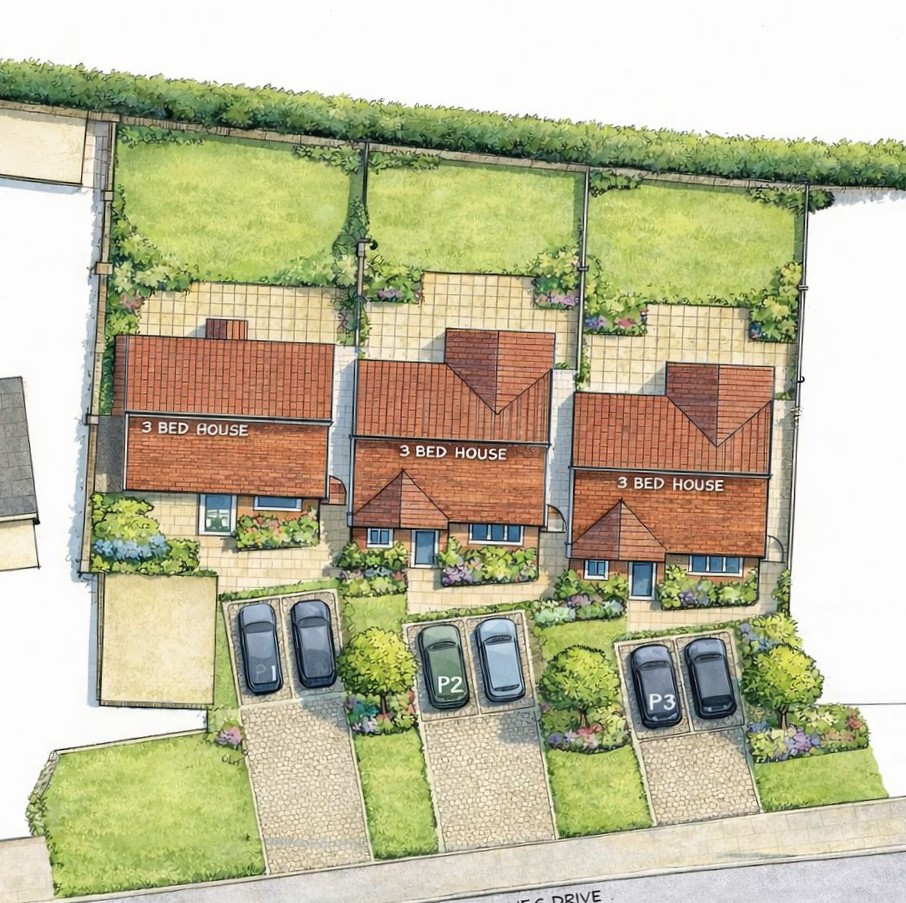
The image below should ideally show a small residential plot or side garden example, because this is exactly where many landowners overestimate what will fit.
Is there a minimum plot size to build a house in the UK?
Not as a simple one-line national rule.
That surprises a lot of people, because it feels like there should be a standard square metre figure that automatically tells you yes or no.
But planning does not usually work like that. Councils tend to assess whether the proposal creates a good-quality place to live and whether it causes problems in terms of access, parking, overlooking, massing or overdevelopment.
So the real question is often not:
“What is the minimum plot size?”
but:
“Is my plot big enough to accommodate a house properly?”
If your land forms part of an existing home, you should also read our guide on
whether you can build in your garden in Essex
,
as many small plots come from garden land, side land or the subdivision of a larger residential plot.
What actually determines whether a plot is big enough?
In reality, a plot is judged by how it performs against a number of planning and design tests.
1. Access
Access is often the biggest constraint on a small plot. A site may appear large enough for a new house, but if you cannot get safe and suitable access to it, the scheme can quickly fall away.
2. Parking
Parking takes up more room than many people realise. Once you allow for parking spaces, turning areas, visibility and practical manoeuvring, the usable build area can reduce quite sharply.
3. Shape of the site
A regular, well-proportioned plot is far more efficient than an awkward wedge, narrow strip or landlocked parcel. Two plots with the same area can produce very different planning outcomes.
4. Relationship with neighbours
Overlooking, loss of privacy, overshadowing and the sense of overdevelopment all matter. Councils will not only look at whether a house physically fits, but whether it fits acceptably.
5. Character of the area
If the surrounding area is made up of spacious detached houses on large plots, a cramped new dwelling squeezed into a tiny corner is more likely to face resistance.
6. Internal quality of the home
It is not just about getting a house onto the land. The proposed dwelling still needs to work as a home, with sensible internal space, light, outlook and usable amenity space.
Simple rule
A plot is only “big enough” if a house can be designed on it properly, not just squeezed onto it on paper.
Why there is no single magic number
Many landowners search for a simple answer such as:
“You need at least X square metres to build a house.”
The problem is that a small plot in one location may work perfectly well, while a larger plot elsewhere may fail because of poor access, an awkward shape or planning constraints.
That is why a small urban infill plot can sometimes succeed, while a seemingly generous suburban garden plot can be refused. It is not only the amount of land that matters. It is how the site functions in planning terms.
What does this mean in Essex?
In Essex, one of the main practical constraints on small plots is often parking and access design. Once realistic parking provision and manoeuvring are added, some plots that look fine at first glance start to feel very tight.
This is one reason why a plot that appears “just about big enough” may still not be the right shape or depth to support a sensible scheme.
If you are looking at a larger parcel of land rather than a single plot, see our guide on
how many houses you can build on an acre in Essex
,
which helps explain how layout, density and planning constraints affect overall site capacity.
Typical situations where small plots can work
Although every site is different, smaller build plots are often created from:
- side gardens next to existing houses
- redundant garage plots
- wide frontage plots that can be split
- backland sites with workable access
- corner plots with a strong street relationship
The strongest small plots usually have a clear access point, a sensible shape and enough room for parking without making the development feel cramped.
Typical reasons small plots fail
- the plot is too narrow once access is included
- there is not enough room for parking and turning
- the new house would overlook or dominate neighbours
- the proposal looks forced or out of character
- the site is technically large enough, but not practically usable
This is where many landowners get caught out. They measure the land area, but not the planning reality.
Is there a minimum garden size needed to split off a plot?
Again, there is no universal number that applies everywhere.
A garden plot has to be judged on whether it can provide a suitable dwelling, amenity space, parking, access and a reasonable relationship with surrounding homes.
That is why two gardens of a similar size can produce very different outcomes. One may have obvious road frontage or side access. The other may be landlocked and much harder to develop.
Want to know if your plot is actually big enough?
We provide a free initial review for landowners in Essex who want a realistic view on development potential.
- whether the plot may be suitable in planning terms
- likely access or parking issues
- whether the site feels too tight or may work with the right layout
- what that could mean for land value
Call 0800 612 2100 or get in touch through our website for a free initial discussion.
Frequently asked questions
What is the minimum plot size for a 3-bedroom house in the UK?
There is no fixed national plot size rule for a 3-bedroom house. Whether a plot is suitable depends on the design, parking, access, internal layout and how the scheme fits the surrounding area.
Can I build a house on a small plot in Essex?
Sometimes, yes. Small plots can work well where access is clear, the shape is efficient and the proposal sits comfortably within its setting.
Is square metre size all that matters?
No. Plot width, depth, shape, access and parking can be just as important as total area.
Can a garden plot be too small even if a house technically fits?
Yes. A proposal can still be refused if it feels cramped, harms neighbouring amenity or creates a poor standard of accommodation.
Should I speak to an agent first?
Usually it makes sense to understand the planning reality first. Overestimating what a plot can deliver can distort expectations and value.
If selling is already on your mind, you may also want to read
how to sell land in Essex
.
Final thought
So, what is the minimum plot size to build a house in the UK?
There is no simple national minimum that guarantees success. What matters is whether the plot can accommodate a well-designed home with proper access, parking and a layout that works in planning terms.
In Essex especially, small plots can be valuable, but only if they stand up to real planning scrutiny. The key is not just asking how big the plot is. It is asking whether it genuinely works.