If you own around 1 acre of land in Essex, one of the first questions you are likely to ask is:
how many houses could actually fit on the site?
The honest answer is that it depends on far more than just the size of the land. In some cases, 1 acre may only support
4 to 6 houses. On a better-positioned site, it may support
8 to 12 houses. In stronger urban or edge-of-settlement locations, the number can sometimes go higher.
If you’re also trying to understand what that might mean financially, it’s worth reading our guide on
how much 1 acre of land is worth in Essex
,
as the number of homes a site can support has a direct impact on its value.
Quick answer
On paper, 1 acre of land can often support:
- 4 to 8 houses at lower density
- 8 to 15 houses at medium density
- 15 to 30+ homes at higher density
In Essex, many realistic small residential schemes tend to fall closer to around 5 to 12 homes per acre,
depending on planning constraints, access and layout.
Why 1 acre does not always mean a fixed number of houses
A common mistake is assuming that 1 acre automatically produces a certain number of plots. In reality,
planning officers and site designers do not start with land size alone. They look at how the site works in practice.
Two 1-acre sites in Essex can produce very different outcomes. One may suit a modest development of detached homes.
Another may support a tighter scheme. A third may lose a large part of its usable area to access, layout constraints
or neighbouring impact.
This is also why many landowners first explore whether development is even possible at all. If that applies to you,
see our guide on
whether you can build in your garden in Essex
.
What determines how many houses you can build?
The final number usually comes down to a combination of the following:
- Location – village, edge of settlement or town
- Planning policy – local council approach
- Access – often the biggest constraint
- Parking requirements
- Neighbouring properties
- Site shape and layout efficiency
- Trees, drainage and other constraints
In many cases, we see sites lose 30–50% of their theoretical capacity once these factors are properly applied.
Simple rule
Land size tells you what might be possible in theory. Planning and layout determine what is actually achievable.
Typical density ranges for Essex
Low density (4–8 houses)
Common in rural or edge-of-village locations where spacing and character matter more.
Medium density (8–15 houses)
Often the realistic range for many sites in Essex with decent access and layout potential.
Higher density (15+ homes)
Typically only achievable in stronger urban locations or where planning policy supports it.
Real-world examples
Here’s how it typically plays out:
- Village edge: 4–6 houses
- Suburban infill: 8–12 houses
- Town location: 12–20 homes
How this impacts land value
The number of houses a site can support directly affects its value.
A site that supports 5 homes will sit in a very different value range to one that supports 10 or 15.
That’s why understanding density is often the first step before exploring sale or development.
If you’re considering selling, you may also want to read:
how to sell land in Essex
.
Why landowners get this wrong
Most landowners overestimate how many homes will fit. That’s completely normal.
The reality is that access, layout and planning constraints reduce numbers more than expected.
This is why a proper planning-led appraisal is critical before making decisions.
Want a realistic answer for your site?
If you own land in Essex, we can give you a clear view of what your site could actually deliver.
- Approximate number of homes
- Planning likelihood
- Access constraints
- Potential land value
Call 0800 612 2100 or submit your site for a free initial review.
Final thought
So how many houses can you build on 1 acre in Essex?
In most cases, somewhere between 4 and 15 homes is realistic,
but every site is different.
The real value comes from understanding what your specific piece of land can deliver – not what a generic average suggests.
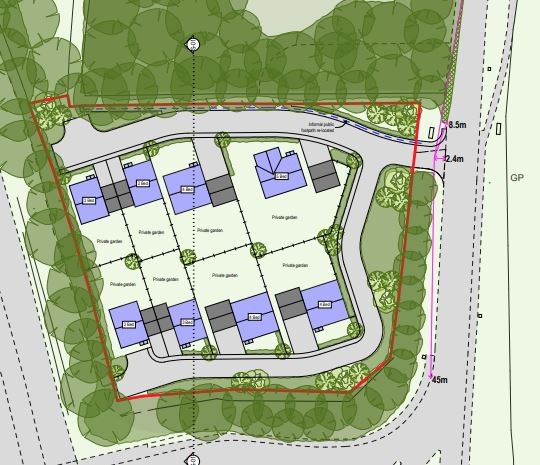
The image below shows a typical example of how housing layouts translate into real-world density on a 1-acre site in Essex.